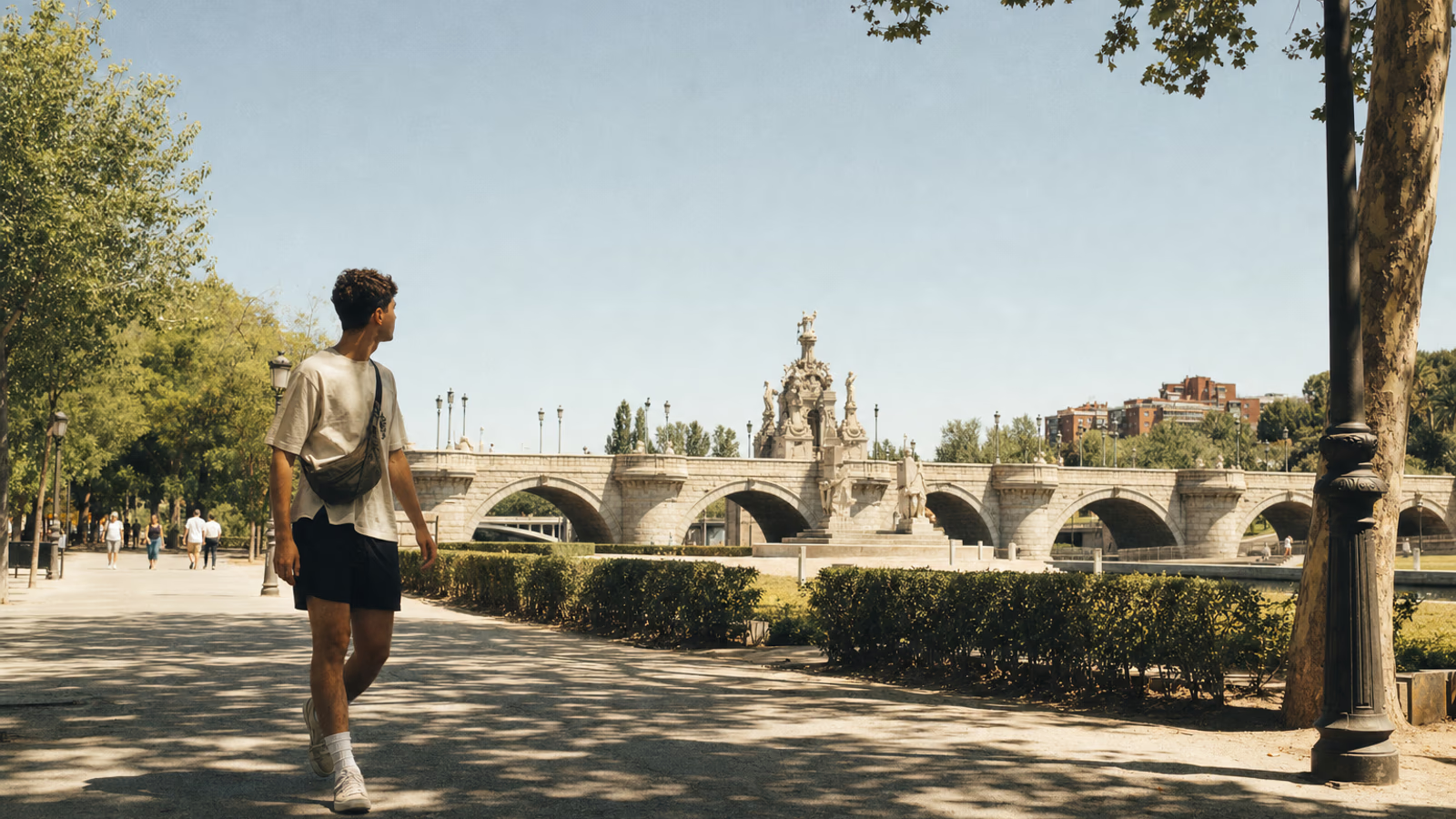
Madrid Río is a transformative urban park that redefines the connection between Madrid and the Manzanares River, blending nature, culture, and leisure.
What is Madrid Río and how do you get there?
The project's ambition is hard to overstate. It involved burying a six-lane ring road, an immense feat of engineering that effectively gifted the city kilometres of new public land. What was once a chasm of exhaust fumes and constant traffic, severing communities from each other, was transformed into a continuous landscape for leisure and culture. It reconnected Madrid.
From our hostels near Sol and Plaza Mayor, the park is a fascinating walk away. You descend from the dense, historic core, heading west past the formidable foundations of the Palacio Real, and suddenly the urban fabric opens up. In about twenty minutes, you find yourself crossing one of the historic bridges, like the Puente de Segovia, and stepping into a completely different Madrid.
Alternatively, you can reach Madrid Río via public transport. The nearest Metro stations include Príncipe Pío (Lines 6, 10, and R) and Legazpi (Lines 3 and 6), both of which provide easy access to different sections of the park. Bus routes such as 25 and 50 also stop nearby, making it convenient for visitors staying in various parts of the city.
Outdoor activities at Madrid Río
The park unfolds as a long, flowing ribbon of deliberate calm and focused activity. We see dedicated runners tracing the river's contours and cyclists moving along pristine, dedicated lanes, while others find quiet lawns for yoga or reading. For us, the real pleasure lies in observing the careful choreography of the space, a place designed for both movement and stillness.
Even the seventeen playgrounds feel less like standard equipment and more like landscape sculptures designed to be inhabited. Great trunks of raw wood form abstract forests for climbing, while entire hillsides are integrated with slides and nets. In summer, the ground itself comes alive, with choreographed water jets that become an impromptu, joyful public space for cooling down.
For those who enjoy sports, Madrid Río offers facilities for football, basketball, and even skateboarding. The skate park near the Arganzuela footbridge is particularly popular among local youth and visitors alike. Additionally, the park's proximity to the Manzanares River allows for unique activities like kayaking, with rental services available during the warmer months.
A cultural stroll through Madrid Río
The park is, in essence, a cultural axis as much as a green one. At its southern end stands the magnificent Matadero Madrid, a former municipal slaughterhouse whose sprawling Neo-Mudéjar pavilions have been masterfully repurposed. The scale is industrial, the brickwork intricate; it's a powerful dialogue between its utilitarian past and its present as a vibrant centre for contemporary creation.
As you walk north, the river is spanned by several historic structures, but the Puente de Toledo is a granite masterpiece of Baroque engineering that always commands our attention. We recommend pausing at its midpoint, between the stone figures of the city's patrons, to observe the view. The bridge's robust, classical form provides a perfect frame for the modern, flowing lines of the park below.
Art enthusiasts will also appreciate the various sculptures and installations scattered throughout the park. These pieces, often created by renowned Spanish artists, add an additional layer of cultural depth to your visit. Don't miss the 'Salón de Pinos,' a linear grove of pine trees that doubles as an open-air gallery.
Here, you witness the city breathing again—a place where the river's memory, industrial architecture, and green public space have found a compelling new equilibrium.
When is the best time to visit Madrid Río?
What guests ask us every week is about the best time to visit. Each season offers a distinct character. Spring brings an almost architectural canopy of blossoms along the main pine-lined avenues, a truly immersive experience. Autumn, however, paints the riverbanks in ochre and gold, with a crisp, clear light that is perfect for long, contemplative walks. The atmosphere completely shifts.
Summer demands a different approach, aligned with the local rhythm. The Madrid sun is unforgiving, so we find the park is best enjoyed in the slanted light of early morning or during the long, golden hours before dusk. On the hottest days, the 'urban beach' near the Arganzuela footbridge becomes the social heart of the park, its water jets a magnet for everyone.
Winter, though quieter, has its own charm. The crisp air and fewer crowds make it an ideal time for photography or simply enjoying the park's serene beauty. The holiday season often brings festive decorations and events, particularly near Matadero Madrid, adding a touch of magic to your visit.
Is Madrid Río suitable for all travellers?
Madrid Río offers a powerful counterpoint to the monumental, dense core where our hostels are located. It's for travellers who want to understand the city's full composition: the historic heart and the modern, breathing lungs. It provides a sense of scale and openness that enriches your perspective on the capital as a whole. It's a different kind of intensity.
Families will find the park particularly accommodating, thanks to its numerous playgrounds and open spaces. Couples can enjoy romantic strolls along the riverbank, while solo travellers might appreciate the tranquility and opportunities for reflection. Accessibility features, including ramps and wide paths, ensure that visitors with mobility challenges can also fully enjoy the park.
Ultimately, Madrid Río is more than just a park; it's a legible narrative of the city's evolution. It’s a space where you can physically trace the layers of Madrid's history—from its 18th-century granite bridges to its 20th-century industrial heritage and its ambitious 21st-century reinvention. This is a walk through time, guided by the river.
More at interhostales.es: Inter Plaza Mayor · Inter Puerta del Sol · our rooms
Further reading: Matadero Madrid · Metro de Madrid
Keep reading: Explore Madrid’s Christmas Spirit Around Sol · Exploring Sol: Life and Culture in Madrid's Heart · Discover Chamberí: A Neighbourhood Full of History and Surprises · Discover Chueca: Diversity, Culture, and Nightlife · Discover Malasaña: Alternative Culture and Nightlife